16 Best Free SEO & Website Optimization Tools to Rank #1
Search engine algorithms are stricter, more sophisticated, and more technically demanding than ever before. Search visibility is no longer just about stuffing keywords into blog posts or accumulating low-grade directory links. Modern organic rankings require a high-precision convergence of technical website hygiene, Core Web Vitals optimization, enterprise-grade cybersecurity posture, and high-relevance intent mapping.
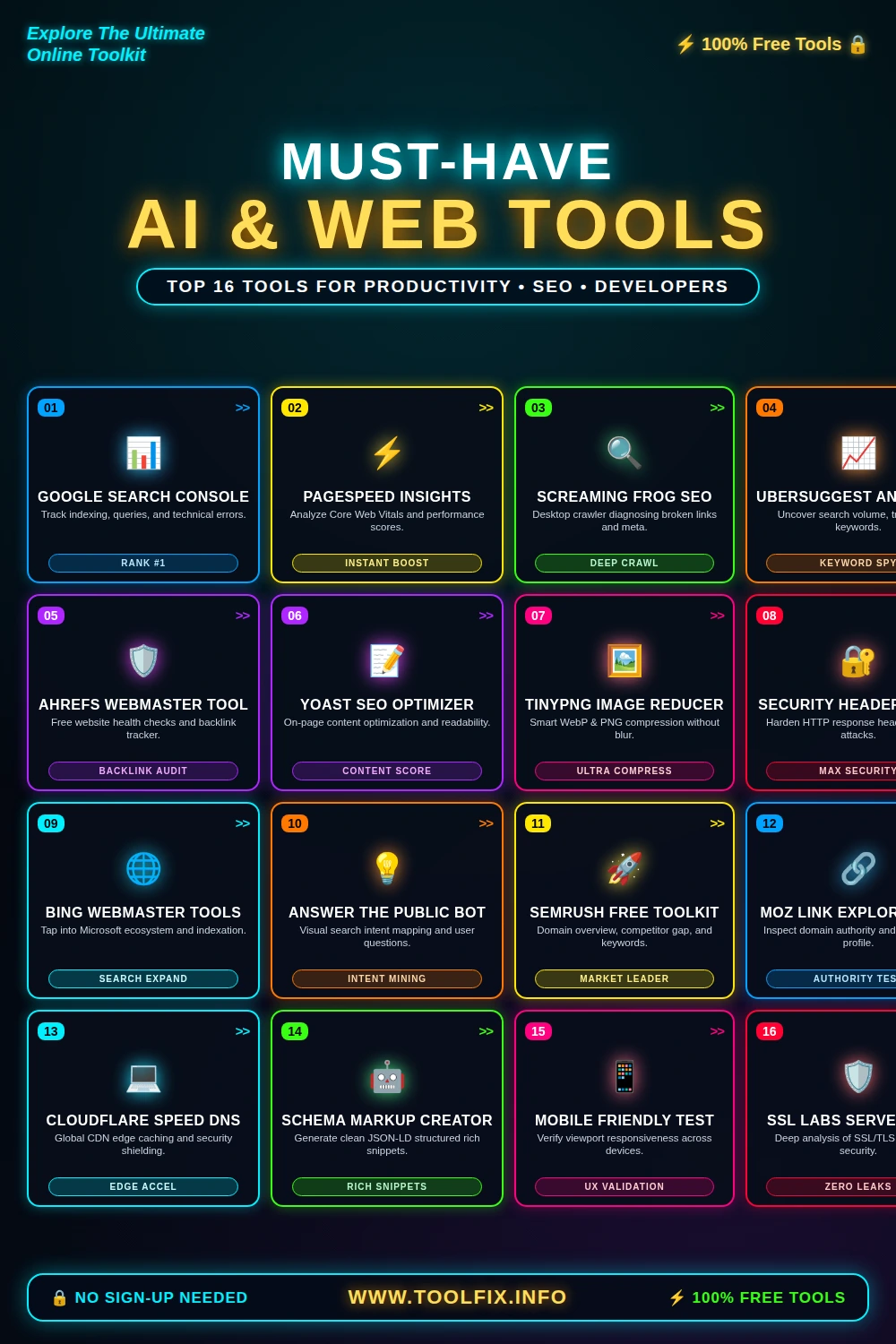
At Toolfix.info, we regularly audit web architectures, dismantle server bottlenecks, and secure digital perimeters. In this ultimate engineering-grade guide, we review the 16 Best Free SEO & Website Optimization Tools that empower developers, system administrators, and digital strategists to achieve number one rankings on Google without burning through enterprise budgets.
1. GOOGLE SEARCH CONSOLE
Google Search Console (GSC) is the bedrock of organic search intelligence. Directly connected to Google’s indexing engine, GSC offers raw, telemetry-level data on how Googlebot perceives, crawls, and indexes your website. Unlike third-party metrics that extrapolate search trends, GSC reveals your true impressions, actual clicks, average positions, and mobile indexing faults.
Primary Use Case: Pinpointing indexation crawl errors, inspecting canonical tags, monitoring Core Web Vitals coverage in the wild, and identifying high-impression pages trapped on SERP page two that can be elevated with minor on-page refinements.
- Pros: Ground-truth first-party Google data; instant sitemap submission; transparent manual penalty notifications.
- Cons: Historical data limited to 16 months; UI caps visible query rows at 1,000 without API extraction.
2. PAGESPEED INSIGHTS
Powered by Google Lighthouse and the Chrome User Experience Report (CrUX), PageSpeed Insights is the ultimate latency and client-side rendering audit utility. It breaks down crucial Core Web Vitals: Largest Contentful Paint (LCP), Interaction to Next Paint (INP), and Cumulative Layout Shift (CLS). PageSpeed Insights isolates both real-world field data and synthetic laboratory data.
Primary Use Case: Diagnosing render-blocking CSS/JavaScript, main-thread execution stalls, unoptimized font delivery, and oversized asset payloads that degrade your page experience score.
- Pros: Accurate lab simulations combined with verified CrUX field telemetry; direct actionable performance recommendations.
- Cons: Lab scores can fluctuate based on server latency variations during run time.
3. SCREAMING FROG SEO
Screaming Frog SEO Spider is the industry-standard local crawler for technical site audits. Its free desktop version crawls up to 500 URLs, capturing structural vulnerabilities such as 404 response codes, server timeouts, redirect loops, duplicated title tags, and orphan assets that siphon away crawl budget.
Primary Use Case: Running comprehensive pre-launch audits, verifying 301 redirection pathways, auditing meta robot directives, and validating internal link architecture.
- Pros: Deep technical introspection; runs locally with zero cloud dependencies; rapid CSV and Excel data export.
- Cons: Free tier limits crawls to 500 URLs; consumes substantial local RAM on JavaScript-heavy single-page apps.
4. UBERSUGGEST ANALYTICS
Ubersuggest by Neil Patel bridges the gap between competitive intelligence and accessible search optimization. Offering a robust free suite, it illuminates competitor keyword strategies, estimated monthly domain traffic, top search pages, and backlink distributions.
Primary Use Case: Performing long-tail keyword discovery, calculating Search Difficulty (SD) before content ideation, and uncovering the exact content assets that drive traffic to your industry rivals.
- Pros: Clean visual dashboards; reliable keyword difficulty scores; useful content topic suggestions.
- Cons: Free tier restricts searches per day; database size in smaller niche regions is less exhaustive than Semrush.
5. AHREFS WEBMASTER TOOL
Ahrefs Webmaster Tools (AWT) is perhaps the most generous free gift to webmasters in the history of SEO. By verifying ownership of your web property via DNS or HTML tags, AWT grants unrestricted access to deep backlink profiling, organic search traffic performance, and recurring technical website health scans.
Primary Use Case: Continuous monitoring of inbound referring domains, finding toxic spam backlink spikes, discovering link decay, and repairing broken inbound links.
- Pros: World-class live link index; granular internal link anchor audits; proactive email alerts for broken links.
- Cons: Limited strictly to properties where you can prove ownership; competitor analysis requires paid subscription.
6. YOAST SEO OPTIMIZER
As the cornerstone WordPress optimization framework, Yoast SEO eliminates technical friction for content producers. It automatically formats XML sitemaps, manages canonical routing, regulates robot directives, and evaluates content readability alongside primary keyphrase density in real time.
Primary Use Case: Enforcing editorial standards across multi-author publishing environments, preventing accidental self-canonical errors, and generating dynamic open-graph preview cards.
- Pros: Comprehensive automated technical baseline; dynamic XML sitemap generation; real-time content scoring.
- Cons: In-content readability algorithm can incentivize rigid writing; displays frequent premium upgrade prompts.
7. TINYPNG IMAGE REDUCER
Oversized images represent more than 60% of modern web page weight, serving as the number one culprit behind failing Core Web Vitals. TinyPNG deploys smart lossy compression algorithms to dramatically reduce the file size of WEBP, PNG, and JPEG images by selectively stripping metadata and optimizing color palettes.
Primary Use Case: Batch-compressing visual assets prior to production deployment to eliminate payload weight without perceptible aesthetic degradation.
- Pros: Exceptional compression ratios up to 70%; maintains partial alpha-channel transparency; simple drag-and-drop batch processing.
- Cons: 5MB single-file upload limit on the free web interface; API free tier limited to 500 compressions monthly.
8. SECURITY HEADERS SCAN
From a cybersecurity perspective, search engines favor safe, resilient web properties. Created by renowned security researcher Scott Helme, SecurityHeaders.com rapidly evaluates your server’s HTTP response headers. It checks for Content Security Policy (CSP), HTTP Strict Transport Security (HSTS), X-Frame-Options, and Referrer-Policy.
Primary Use Case: Verifying that your production server drops clickjacking opportunities, mitigates cross-site scripting (XSS), and proves to crawler bots that your security posture is airtight.
- Pros: Instant grading from A+ down to F; actionable server-header snippets for Nginx, Apache, and Cloudflare; zero registration.
- Cons: Strict focus on HTTP header configs; does not scan database or CMS application vulnerabilities.
9. BING WEBMASTER TOOLS
Dismissing Bing is a strategic error. Powering search queries across Windows, Microsoft Copilot, Yahoo, and DuckDuckGo, Bing accounts for significant, high-converting desktop traffic. Bing Webmaster Tools offers advanced features, including the IndexNow protocol for real-time instantaneous URL indexing.
Primary Use Case: Enabling IndexNow to submit new content immediately to search indexes, running keyword research against enterprise search indexes, and monitoring AI-driven search query feeds.
- Pros: Free integrated SEO audit engine; instant IndexNow integration; uncluttered competitive intelligence.
- Cons: Lower search volume sample sizes compared to Google; smaller third-party API plugin ecosystem.
10. ANSWER THE PUBLIC BOT
Modern search engines deploy semantic models that rank complete problem-solving architectures rather than isolated keywords. AnswerThePublic mines Google’s autocomplete search queries, categorizing raw user demand into who, what, where, why, and how visual search branches.
Primary Use Case: Architecting FAQ schema sections, structuring comprehensive H2 and H3 outlines, and identifying conversational search queries generated by voice and conversational AI search assistants.
- Pros: Unrivaled question-intent discovery; intuitive graphical visual map exports; ideal for featured-snippet discovery.
- Cons: Free tier limits daily queries per user IP address; does not include historical CPC or competition indices directly.
11. SEMRUSH FREE TOOLKIT
Even without an enterprise tier, Semrush provides 10 free daily requests across its domain overview, keyword magic, and backlink audit databases. This makes it an indispensable intelligence weapon for surgical competitor investigations and SERP snapshot analysis.
Primary Use Case: Analyzing your primary competitor’s top-performing organic keywords, discovering high-potential keyword gaps, and calculating SERP intent clusters.
- Pros: The world’s most comprehensive commercial keyword database; clear commercial vs. informational intent tagging.
- Cons: Strict daily usage quotas on the free tier; UI contains aggressive upsells to enterprise packages.
12. MOZ LINK EXPLORER PRO
Moz invented Domain Authority (DA) and Page Authority (PA)—metrics that provide a quick benchmark for ranking potential. Moz Link Explorer allows users to query ten free domain lookups per month to calculate trust metrics, backlink health, and Spam Score distributions.
Primary Use Case: Vetting link acquisition prospects, analyzing competitor DA vectors, and evaluating link equity distribution before initiating outreach campaigns.
- Pros: Industry-recognized DA/PA metrics; granular Spam Score calculations; fast inbound anchor text analysis.
- Cons: Limited daily query credits without a Moz Pro subscription; index crawling updates slower than Ahrefs.
13. CLOUDFLARE SPEED DNS
Network latency directly degrades Time to First Byte (TTFB). Cloudflare’s free edge network tier equips your website with an ultrafast Anycast DNS resolver, global CDN caching, automated Brotli compression, HTTP/3 protocol support, and DDoS protection.
Primary Use Case: Eliminating geographic server latency, securing web assets from automated scrapers and brute-force bots, and accelerating asset delivery to international users.
- Pros: Completely free CDN and SSL provisioning; industry-leading DNS response latency; automated edge optimization.
- Cons: Requires updating your domain’s nameservers; edge caching rules demand careful configuration to avoid stale dynamic data.
14. SCHEMA MARKUP CREATOR
Structured data is the primary interface through which modern AI engines and Google algorithms process the semantic meaning of your content. Merkle’s Schema Markup Generator creates clean, spec-compliant JSON-LD data for Articles, FAQs, Products, How-Tos, and Organizations.
Primary Use Case: Generating machine-readable rich snippets that double SERP click-through rates (CTR) by earning star ratings, breadcrumb trails, and expandable FAQ elements in search results.
- Pros: Generates error-free JSON-LD instantly; supports the full spectrum of Schema.org formats; direct test integration with Google.
- Cons: Manual copy-pasting required for dynamic CMS templates without custom theme hooks.
15. MOBILE FRIENDLY TEST
Google executes its indexation exclusively via Mobile-First indexing. The open Mobile-Friendly test environment validates whether your CSS viewports adjust gracefully across smartphone viewports, flags clickable elements placed too close together, and detects horizontal scrolling errors.
Primary Use Case: Ensuring zero responsive design failures, optimizing touch targets for conversion UX, and eliminating viewport rendering anomalies that trigger Googlebot indexing devaluations.
- Pros: Clear screenshot outputs depicting true smartphone rendering; highlights blocked assets that prevent proper evaluation.
- Cons: Scans one page at a time rather than crawling entire site hierarchies automatically.
16. SSL LABS SERVER TEST
HTTPS is a confirmed Google ranking signal, but simply having a basic padlock icon is not enough. Qualys SSL Labs performs an exhaustive cryptographic audit of your web server’s SSL/TLS deployment. It grades your protocol support (TLS 1.2, TLS 1.3), evaluates cipher suites, tests for Heartbleed/Poodle vulnerabilities, and confirms certificate chain integrity.
Primary Use Case: Upgrading server encryption to achieve an A+ security grade, ensuring zero user warnings, and preventing data interception vulnerabilities across all user sessions.
- Pros: The worldwide authority on transport layer security verification; highlights weak ciphers and outdated handshake protocols.
- Cons: Test takes roughly 60 seconds per host; requires root or webmaster access to modify server configs.
The Technical SEO & Security Master Checklist
Achieving top SERP rankings requires a systematic implementation strategy. When you combine technical optimizations, security configurations, and user experience enhancements, search engines reward your web property with higher crawl priority and better rankings. Follow this structured roadmap to maximize the value of these 16 free tools:
- Establish Telemetry: Verify your domain in both Google Search Console and Bing Webmaster Tools. Connect the IndexNow API protocol for immediate publication indexation.
- Harden the Foundation: Run your domain through SSL Labs and Security Headers. Ensure your server enforces TLS 1.3, HSTS preloading, and a robust Content Security Policy to earn an A+ baseline.
- Eliminate Asset Bloat: Route DNS through Cloudflare and batch-compress all site images through TinyPNG. Aim to keep all individual image assets below 100KB whenever possible.
- Crawl & Repair: Launch Screaming Frog to locate broken 404 links, redirect chains, missing H1 elements, and non-canonical pages. Repair them at the server configuration level.
- Inject Semantic Data: Deploy JSON-LD structured data via Schema Markup Generator for key FAQs, review cards, and authorship profiles.
- Analyze User Search Intent: Use AnswerThePublic and Semrush to discover conversational long-tail queries, then expand your content to provide direct, factual, and actionable solutions.
By leveraging this free 16-tool optimization stack, you can dismantle technical barriers, boost page speed, secure user trust, and outrank high-budget enterprise competitors across every major search index.
Explore more free utilities at Toolfix.info — 100% free with zero registration.