
16 Powerful Developer & Coding Utilities for Fast Productivity
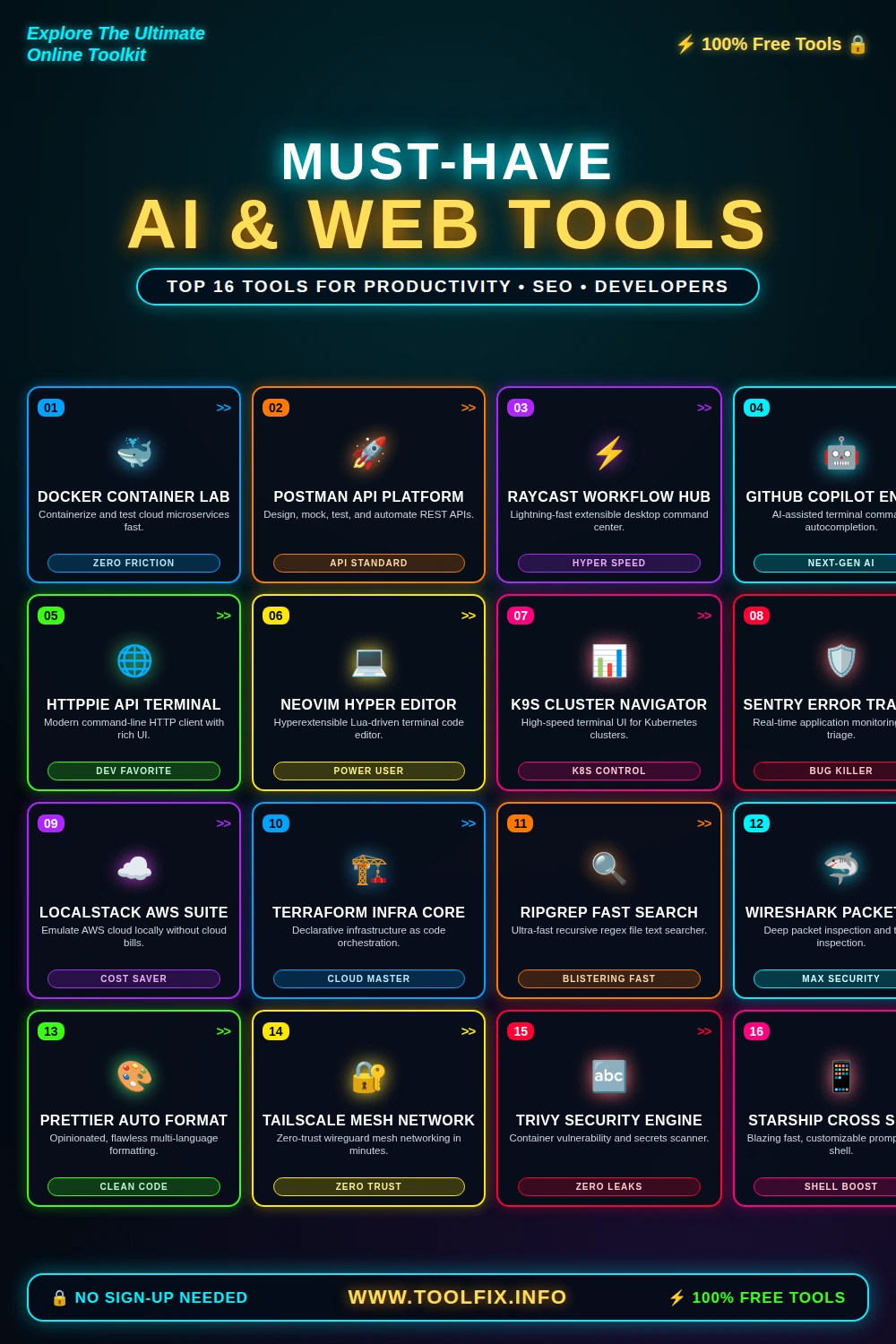
Modern software engineering is an exercise in managing cognitive load. Between microservice topologies, cryptographic verification, continuous delivery pipelines, and distributed debugging, engineers lose an estimated 3.8 hours every day to context switching, pipeline delays, and sub-optimal tooling. Elevating engineering velocity requires deliberate curation of developer utilities that eliminate operational friction, harden endpoints, and speed up execution cycles.
The Architecture of Modern Developer Velocity
Developer productivity is no longer defined merely by typing speed or syntax familiarity; it hinges on how quickly an engineer can validate hypotheses across distributed networks without introducing vulnerabilities. High-performing engineering organizations prioritize three foundational pillars in their local workstations: low-latency execution, declarative automation, and shift-left security inspection. The 16 tools reviewed below form a cohesive developer stack engineered for maximum throughput and uncompromising security compliance.
1. DOCKER CONTAINER LAB
Containerization transformed deployment, but Docker Container Lab remains the bedrock of local microservice execution. By standardizing development environments within isolated Linux namespaces, developers eradicate the notorious ‘works on my machine’ anomaly. Containerized environments allow rapid instantiation of Redis caches, PostgreSQL instances, and message brokers with zero persistent pollution of the host kernel.
Security Directive: Always bind ports to localhost explicitly (127.0.0.1:5432:5432) during local debugging to prevent accidental exposure over untrusted local area networks or public Wi-Fi hotspots.
- Pros: Total isolation of runtime dependencies, reproducible test scaffolding, rich OCI image ecosystem.
- Cons: High memory consumption on macOS and Windows hypervisors when spinning up extensive Docker Compose clusters.
2. POSTMAN API PLATFORM
Postman has matured from a simple HTTP request runner into an enterprise API lifecycle hub. Engineers utilize its integrated testing harnesses, automated mock servers, and OpenAPI schema generators to validate endpoints before writing a single line of backend implementation. Built-in contract validation ensures frontend and backend teams iterate asynchronously without interface drift.
- Pros: Dynamic test scripting via JavaScript pre-request scripts, automated Newman CLI test runs for CI/CD pipelines.
- Cons: Workspace synchronization can inadvertently transmit sensitive Bearer tokens to cloud workspaces if environment variables are not strictly scoped.
3. RAYCAST WORKFLOW HUB
Raycast replaces conventional application launchers with an ultra-responsive, scriptable command center. Engineered in native Swift with zero electron overhead, it enables developers to control GitHub PRs, query Jira boards, inspect clipboard history, and manage Docker containers via low-latency hotkeys. Custom React and TypeScript extensions make it possible to orchestrate complex internal developer portals straight from the keyboard.
- Pros: Sub-millisecond interface responses, extensible TypeScript SDK, built-in encrypted credential storage.
- Cons: macOS exclusive, creating fragmentation across multi-platform engineering teams.
4. GITHUB COPILOT ENGINE
Deploying specialized LLMs trained on millions of repositories, GitHub Copilot Engine serves as a contextual pair programmer. Beyond code autocompletion, its real value lies in generating boilerplate unit tests, translating complex regular expressions, and parsing cryptic shell commands. In corporate workflows, strict telemetry filters must be enforced to guard against proprietary intellectual property transmission.
- Pros: Unprecedented acceleration in repetitive code generation and test boilerplate construction.
- Cons: Occasional generation of hallucinated dependencies or insecure cryptographic primitives (e.g., suggesting outdated hashing algorithms).
5. HTTPPIE API TERMINAL
cURL is undeniably ubiquitous, but its archaic syntax often slows down interactive exploratory debugging. HTTPpie delivers an intuitive, human-centric terminal interface featuring automatic colorization, persistent session cookies, JSON formatting by default, and streamlined authentication flags. It allows engineers to inspect HTTP headers, status codes, and JSON response bodies with minimal syntactic friction.
# Simple authenticated REST mutation
http --auth-type=bearer --auth="$JWT_TOKEN" POST api.internal.net/v1/deploy service=auth env=staging- Pros: Expressive syntax, native JSON parsing, robust output formatting for terminal reviews.
- Cons: Slower execution overhead compared to raw libcurl in long-running CI loops.
6. NEOVIM HYPER EDITOR
Neovim represents the modern renaissance of modal editing. Built around asynchronous execution, native Language Server Protocol (LSP) orchestration, and deep Lua scripting capabilities, it offers full-featured IDE performance within a sub-second terminal session. Developers achieve flow state by navigating and editing codebases entirely without touching a pointing device, minimizing cognitive context switching.
- Pros: Near-zero RAM footprint, infinite customization via Lua, native Tree-sitter AST syntax processing.
- Cons: Steep initial learning curve requiring disciplined muscle-memory acquisition.
7. K9S CLUSTER NAVIGATOR
Managing Kubernetes clusters via kubectl commands involves high command complexity and context loss during live incidents. K9s provides an interactive curses-based terminal UI that continuously monitors cluster health, streams pod logs, displays real-time resource allocation metrics, and facilitates container port-forwarding with single-key interactions. It drastically reduces recovery metrics during critical production outages.
- Pros: Instant cluster navigation, direct log tailing, automated detection of crash-looping workloads.
- Cons: High administrative privileges can result in accidental resource deletion if RBAC permissions are not strictly scoped.
8. SENTRY ERROR TRACKER
Standard logging tells you something failed; Sentry reveals exactly why, where, and for whom. Operating through lightweight client SDKs, Sentry captures uncaught exceptions, breadcrumbs, unhandled promises, and memory spikes, reconstructing the exact call stack alongside commit-hash mappings. Its breadcrumb tracking captures preceding network requests and user interactions, drastically shrinking debugging timelines from hours to seconds.
- Pros: Precise stack traces mapped to original source maps, automated regression alerts, zero-day bug detection.
- Cons: High event volume can become cost-prohibitive without robust server-side sampling filters.
9. LOCALSTACK AWS SUITE
LocalStack fundamentally alters cloud-native software development by spinning up a functional AWS cloud mock directly inside a local container. Engineers can execute Lambdas, write to DynamoDB tables, route SQS queues, and manage S3 buckets offline. This mitigates runaway cloud utility bills, eliminates the risk of shared test-environment collisions, and guarantees fast local integration testing.
- Pros: Zero cloud execution costs during development, complete isolation from corporate AWS IAM boundaries.
- Cons: Advanced IAM simulation and specialized enterprise AWS engines require commercial licensing.
10. TERRAFORM INFRA CORE
Manual infrastructure deployment is an operational anti-pattern. HashiCorp Terraform enables immutable Infrastructure as Code (IaC) across hybrid and multi-cloud architectures. Its state-file engine parses declarative configuration files into targeted execution graphs, providing deterministic changes across cloud compute, identity access layers, and network routing policies prior to execution.
- Pros: Deterministic dependency tracking via declarative HCL, modular infrastructure reusability across regions.
- Cons: State file concurrency requires remote locking mechanisms (e.g., S3 + DynamoDB) to avoid race conditions.
11. RIPGREP FAST SEARCH
Built with Rust’s high-performance memory safety guarantees, ripgrep (rg) outperforms GNU grep, ack, and the silver searcher. By parsing .gitignore files automatically and using memory-mapped files alongside SIMD acceleration, ripgrep traverses millions of lines across enterprise mono-repositories in milliseconds, surfacing definitions, function calls, and secrets without taxing CPU cycles.
- Pros: Unmatched regular-expression search speed, native respect for VCS ignore parameters.
- Cons: Command arguments differ slightly from classic POSIX grep patterns.
12. WIRESHARK PACKET NET
When high-level diagnostic tooling fails, packet-level ground truth is required. Wireshark performs deep network protocol inspection across the OSI model. Cybersecurity analysts and distributed systems engineers utilize Wireshark to dissect anomalous TLS handshakes, pinpoint TCP retransmissions causing latency spikes, and expose unencrypted payloads across production ingress controllers.
- Pros: Unrivaled protocol parsing capability, microsecond timestamp precision for packet latency analysis.
- Cons: Massive pcap capture files consume disk rapidly; requires granular display filter proficiency.
13. PRETTIER AUTO FORMAT
Debating indentation depth, line wrapping, and quotation styles during pull request reviews drains valuable engineering focus. Prettier enforces an opinionated, automated standard across HTML, TypeScript, JSON, CSS, and Markdown. Integrated via git hooks (using Husky or lint-staged), it formats code upon commit, completely removing stylistic friction from code review conversations.
- Pros: Eradicates bikeshedding in code reviews, deterministic AST-based code reprinting.
- Cons: Minimal configuration flags can feel restrictive for teams with non-standard formatting rules.
14. TAILSCALE MESH NETWORK
Tailscale establishes encrypted peer-to-peer mesh networks utilizing the modern WireGuard protocol. It eliminates the latency, single-point-of-failure architectures, and operational overhead of legacy hub-and-spoke enterprise VPNs. Engineering teams securely access staging databases, internal development clusters, and on-premises build servers through single sign-on (SSO) and granular role-based ACLs.
- Pros: Zero-configuration NAT traversal, robust WireGuard end-to-end encryption, integration with identity providers.
- Cons: Requires installation of the Tailscale daemon across all participating nodes and ephemeral CI machines.
15. TRIVY SECURITY ENGINE
Software supply chain attacks have made local vulnerability scanning mandatory. Trivy is a comprehensive, open-source security scanner that detects CVEs, misconfigurations, and hardcoded secrets within container images, Git repositories, and Kubernetes manifests. Running Trivy locally stops vulnerable package versions from ever reaching the centralized container registry.
- Pros: Lightning-fast vulnerability database sync, multi-layer container image scanning, SBOM generation.
- Cons: High vulnerability counts on legacy base images require nuanced severity filtering to prevent alert fatigue.
16. STARSHIP CROSS SHELL
Context awareness is critical when executing sensitive terminal operations. Starship provides an ultra-fast, minimalist, and highly customizable prompt for any shell (Bash, Zsh, Fish). Engineered in Rust, it renders current Git branch status, untracked changes, Node/Python/Go version contexts, and Kubernetes namespaces instantly without introducing shell latency.
- Pros: Universal shell compatibility, zero measurable prompt lag, immediate visibility of branch state.
- Cons: Requires modern Powerline-compatible Nerd Fonts for optimal visual glyph rendering.
Engineering Workflow Blueprint: Putting It All Together
Integrating these utilities into a seamless pipeline compounds their individual productivity benefits. A resilient, highly optimized daily development loop follows a distinct cadence:
1. Environment Initialization: Deploy local service dependencies via Docker Container Lab and LocalStack. Verify isolation and connectivity over a secure Tailscale Mesh Network without opening public firewall ports.
2. Rapid Implementation: Write code inside Neovim, supported by GitHub Copilot for boilerplate and ripgrep for instant code search across vast mono-repos. Keep your execution context clear with the informative Starship shell.
3. API Verification: Test endpoints and contracts using HTTPpie and Postman, ensuring response payloads match backend specifications before running integration suites.
4. Security Hardening & Hygiene: Format changed files cleanly with Prettier, analyze image security locally with Trivy to intercept CVEs early, and inspect network traffic patterns via Wireshark.
5. Observability & Deployment: Orchestrate deployment blueprints with Terraform, monitor running pods via K9s, and rely on Sentry to catch runtime anomalies before they affect users.
Conclusion: Velocity Requires Discipline
Speed in modern software engineering is not about rushing code into production; it is about eliminating roadblocks that cause delays, friction, and security blind spots. By adopting this unified suite of 16 high-performance developer utilities, teams cultivate a resilient engineering culture where deployment cycles accelerate, cognitive overhead drops, and software quality remains exceptionally high.
Explore more free utilities at Toolfix.info — 100% free with zero registration.