
E-Commerce Profit Margins & Product Pricing Formula (2026): The Complete Amazon, Shopify & Etsy Playbook
- Model Your Exact Product Profit & Pricing
- 1. The #1 Pricing Mistake: Markup vs. Profit Margin
- Markup Percentage
- Gross Profit Margin Percentage
- 2. 2026 Platform Fee Audit: Where Does Your Revenue Go?
- 3. True Landed COGS: The 5 Cost Layers You Must Account For
- 4. Factoring Customer Acquisition Cost (CAC) and Return Rates
- Blended Ad Spend Per Unit (eCPA)
- The Real Cost of Customer Returns
- 5. Mathematical Case Study: Real Unit Economics of a $50 Retail Product
- Comparison: $49.99 Product (Landed COGS = $12.00)
- 6. How to Calculate Break-Even Sales Volume
- Audit Your Product Margins in Seconds
- 7. Frequently Asked Questions (FAQ)
- What is a good net profit margin for an e-commerce brand?
- Should I price my products with free shipping or charge separate shipping?
- How often should I review and adjust product pricing?
Model Your Exact Product Profit & Pricing
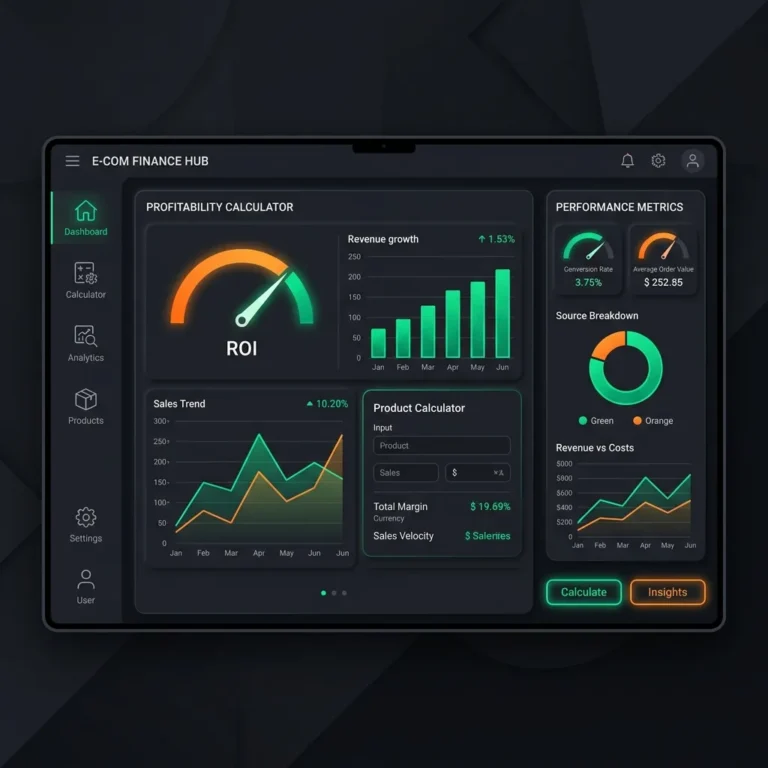
Audit real-time fee deductions across Amazon, Shopify, and Etsy, or compute target selling prices to protect your bottom line.
Generating top-line revenue in e-commerce is relatively straightforward; generating sustainable, cash-in-bank net profit is where 90% of direct-to-consumer (DTC) and marketplace sellers fail. In today’s hyper-competitive commerce landscape, relying on crude “3x cost of goods” rules of thumb is a fast track to insolvency.
Between stealth platform commission updates, fluctuating freight surcharges, rising digital advertising Customer Acquisition Costs (CAC), and customer return rates, e-commerce founders must treat product pricing as an exact mathematical discipline. A seemingly negligible 3% pricing error on a $50 item can completely obliterate an entire quarter of operating profits.
In this 2026 masterclass, we break down the definitive mathematics of e-commerce profitability: the catastrophic markup vs. margin mistake, exact platform fee breakdowns across Amazon, Shopify, Etsy, and TikTok Shop, landed COGS architecture, and how to use our free interactive calculators to safeguard your business.
1. The #1 Pricing Mistake: Markup vs. Profit Margin
The most widespread financial mistake e-commerce operators make is conflating Markup Percentage with Gross Profit Margin Percentage. While they use the same dollar inputs, their mathematical bases are fundamentally different:
Markup Percentage
Markup measures the percentage added directly on top of your product cost to arrive at your selling price:
Gross Profit Margin Percentage
Margin measures what percentage of your final selling price is retained as profit after covering costs:
Why This Destroys Margins: If an item costs $20 to manufacture and you apply a 50% markup, your retail price is $30 ($20 + $10). Your profit is $10. However, your profit margin is only 33.3% ($10 / $30). If you subsequently offer a 25% site-wide promotional discount or spend 15% on digital ads, you have instantly eliminated your entire operating profit. To guarantee a 50% profit margin on a $20 item, you must sell it for $40.00 (a 100% markup).
2. 2026 Platform Fee Audit: Where Does Your Revenue Go?
Every major sales channel extracts a distinct toll on your retail price. Understanding your channel-specific fee schedule is essential when deploying multi-channel commerce:
| Platform | Core Commission / Take Rate | Payment Processing Fee | Hidden Overhead to Model |
|---|---|---|---|
| Shopify (DTC) | 0% (with Shopify Payments) | 2.9% + $0.30 (Basic plan) | App stack subscriptions ($150-$500/mo), Chargebacks |
| Amazon (FBA) | 15% Referral Fee (Category avg) | Included in referral fee | FBA pick & pack fees ($3-$7/unit), Low-inventory fees, Storage |
| Etsy | 6.5% Transaction Fee | 3.0% + $0.25 (Etsy Payments) | $0.20 listing renewal fee / 4 months, Offsite Ads (12-15%) |
| TikTok Shop | 6.0% Commission Fee | Included in platform rate | Affiliate creator commissions (10%-20%), Live shopping discounts |
Notice that selling on Amazon requires an immediate 15% deduction from gross revenue before fulfillment and shipping costs are calculated. On our E-Commerce Profit Calculator, you can toggle between these platforms with one click to see how platform fees instantly shift your net take-home pay.
3. True Landed COGS: The 5 Cost Layers You Must Account For
Too many merchants calculate cost of goods solely from the supplier’s ex-factory quote (e.g., “$8.00 per unit on Alibaba”). In reality, your true Landed Cost of Goods Sold (Landed COGS) comprises five distinct layers:
- Factory Production Cost: The raw manufacturing cost per finished unit, including product labeling and primary retail packaging.
- Freight & Logistics: Sea container shipping, air express, port handling, customs clearance brokerage, and domestic freight transportation to your warehouse or 3PL.
- Customs Duties & Tariffs: Import taxes levied under Harmonized Tariff Schedule (HTS) codes.
- Inbound Warehousing & 3PL Prep: Barcoding (FNSKU), poly-bagging, carton labeling, and receiving fees charged by your fulfillment center.
- Damage & Defect Reserve: Factoring an industry-standard 2% to 4% allowance for factory defects, transit damages, and broken inventory.
Always calculate freight per unit as: Total Inbound Shipping Invoice ÷ Total Saleable Units Received. A $6 factory item often carries a true landed cost of $9.50 once tariffs and ocean freight are accounted for.
4. Factoring Customer Acquisition Cost (CAC) and Return Rates
In modern e-commerce, advertising is no longer an optional growth lever; it is a variable cost of goods sold. When evaluating unit economics, you must model two additional drains on margin:
Blended Ad Spend Per Unit (eCPA)
If your marketing team spends $5,000 on Meta and Google Ads in a month and generates 500 orders, your Cost Per Acquisition (CPA) is $10.00. Every single product sold must absorb this $10.00 marketing cost before any profit can be claimed.
The Real Cost of Customer Returns
Returns are an inevitable reality of e-commerce, averaging 8% to 12% in general merchandise and up to 25% in apparel. A returned product incurs:
- Lost original shipping cost
- Return reverse shipping postage ($4-$8)
- 3PL restocking and inspection fees ($2-$4)
- Unsalable or damaged packaging requiring liquidation
5. Mathematical Case Study: Real Unit Economics of a Retail Product
Let us look at a real-world financial breakdown of a premium water bottle selling for $49.99 across Shopify DTC versus Amazon FBA:
Comparison: .99 Product (Landed COGS = .00)
| Cost Line Item | Shopify Store | Amazon FBA |
|---|---|---|
| Retail Selling Price | $49.99 | $49.99 |
| Landed COGS | -$12.00 | -$12.00 |
| Platform / Processing Fees | -$1.75 (2.9% + $0.30) | -$7.50 (15% Referral) |
| Fulfillment / Shipping Cost | -$6.50 (3PL Pick & Pack) | -$5.80 (FBA Fulfillment Fee) |
| Marketing / Ad Spend per Sale | -$12.00 (Paid Meta/TikTok Ads) | -$6.00 (Amazon PPC) |
| General Overhead (Packaging, Software) | -$2.50 | -$2.50 |
| Net Cash Profit per Unit | +$15.24 (30.5% Net Margin) | +$16.19 (32.4% Net Margin) |
Analysis: While Amazon takes a hefty 15% referral cut, its lower PPC ad cost and pre-built buyer intent balance out against Shopify’s higher direct advertising costs. Running both channels allows you to diversify risk.
6. How to Calculate Break-Even Sales Volume
Once you know your net profit per unit, you can compute exactly how many units you must sell each month to cover fixed business overhead (Shopify subscriptions, office rent, software tools, virtual assistant payroll):
Break-Even Formula
For example, if your fixed monthly software and overhead expenses are $3,000, and your net contribution margin per product is $15.00:
$3,000 ÷ $15.00 = 200 Units / Month
Every unit sold beyond unit 201 represents pure, unencumbered operating profit.
Audit Your Product Margins in Seconds
Stop guessing your profit numbers. Use our free suite of e-commerce tools to simulate pricing tiers, platform commissions, and break-even targets live.
7. Frequently Asked Questions (FAQ)
What is a good net profit margin for an e-commerce brand?
A healthy net profit margin for a direct-to-consumer (DTC) or Amazon e-commerce business typically sits between 15% and 25% after all ad spend, COGS, and overhead. Margins below 10% leave very little room to absorb ad performance volatility or shipping price spikes, while margins above 30% represent top-tier, highly defensible product brands.
Should I price my products with free shipping or charge separate shipping?
Psychologically, over 75% of online shoppers abandon carts when unexpected shipping fees appear at checkout. The most profitable strategy is to bake your average shipping cost (e.g. $5.00) directly into your retail selling price and advertise “Free Standard Shipping.” This boosts conversion rates without compressing your net margins.
How often should I review and adjust product pricing?
Successful e-commerce brands conduct a formal pricing and margin audit quarterly, and immediately whenever supplier material costs, international freight rates, or platform fee schedules change. Small $1.00 to $3.00 price adjustments on core catalog items routinely deliver six-figure annual bottom-line improvements without hurting conversion volume.